Identifying the entrepreneurship and problem-solving skills of fourth-grade students through engineering design-based STEM activities
Today, the rapid development of science and technology in response to increasing needs requires students to become individuals, who are research-oriented, questioning, enterprising, productive, and proficient at problem-solving in society. To acquire these skills, it is crucial that teaching and learning methods are age-appropriate, connected to daily life, and promote active participation in the learning process (National Research Council (2012)). It seems unlikely that students can develop these skills through education and training activities that are isolated from real-world contexts and solely based on textbooks (Akgündüz et al., 2015; Moore et al., 2014; Yager, 1992). Moreover, the rapid advancement of technology has led to an increasing demand for the development of new and diverse technological tools to maintain an economic advantage in global competition. However, the lack of a sufficient and qualified workforce for production remains a serious issue (Guzey et al., 2014). To address this issue, it is frequently suggested that educational programs should remove the distinctions between the disciplines of science, engineering, technology, and mathematics (Brophy et al., 2008; Çorlu et al., 2014). The most current approach that concretely demonstrates how integrating these disciplines can lead to the production of tools and technologies that simplify daily life is STEM education (Bybee, 2010; National Academy of Engineering and National Research Council [NAE and NRC], 2009; STEM Task Force Report, 2014). The successful implementation of this integrated approach is closely linked to the adoption of a culture within educational systems that fosters interdisciplinary collaboration. In this regard, the need to cultivate a culture of interdisciplinary cooperation among teachers in Turkey (Kılınç and Karabudak, 2024; Ministry of National Education [MoNE], 2018b; PwC Turkey and Turkish Industry and Business Association [TIBA], 2017), along with the inadequacy of inquiry-based learning environments and student-centered feedback mechanisms—which are critical for the effective implementation of STEM education (Akgündüz et al., 2015; Çolakoğlu and Günay Gökben, 2017)—suggests that the development of these competencies should be regarded not only as a pedagogical necessity, but also as a strategic priority for enhancing Turkey’s competitive advantage in the global arena.
STEM education is an integrated approach that enables the concrete and practical exploration of the interconnections among the disciplines of science, technology, engineering, and mathematics (Tsupros et al., 2009). The primary goal of this approach is to cultivate essential lifelong competencies in students, including critical thinking, problem-solving, and innovation (Thomasian, 2011). However, there is no consensus on how these disciplines should be integrated. This uncertainty has led to the emergence of various integration models, including multidisciplinary, interdisciplinary, and transdisciplinary approaches (Bryan et al., 2016; Wang et al., 2011). Among these models, one particularly prominent approach in STEM education is the engineering design process. Engineering design concretizes interdisciplinary connections by offering students opportunities to develop creative solutions to real-world problems (McFadden and Roehrig, 2018).
Engineering is an iterative process that applies principles of science and mathematics to practical problems in order to generate technological solutions (NAE and NRC, 2009). This process not only helps students concretize scientific and mathematical concepts, but also fosters essential life skills such as problem-solving, social entrepreneurship, and teamwork (English, 2016; Guzey et al., 2017; Lachapelle and Cunningham, 2014). Although engineering-oriented STEM practices are widely recognized for enhancing students’ analytical thinking and innovation capacities, their suitability at the elementary level remains a subject of debate. Some researchers argue that engineering processes are often perceived as exceeding the cognitive developmental level of elementary school students, resulting in limited adoption at that stage (English et al., 2017; McFadden and Roehrig, 2018). In contrast, others emphasize that such practices support the development of higher-order skills such as critical thinking, collaboration, and creativity (Bozan and Anagün, 2019; English, 2018; Özkul and Özden, 2020). Researchers indicate that engineering design cycle-based STEM activities enhance students’ higher-order skills such as critical and scientific thinking, teamwork, collaboration, problem-solving, and analytical thinking (Bozan and Anagün, 2019; Capraro and Slough, 2008; English and King, 2017; Morrison, 2006; Okulu and Ünver, 2021; Özkul and Özden, 2020). Additionally, researchers emphasize that engineering design cycle-based STEM activities are systematic, dynamic, and cyclical, which encourages individuals to believe that all problems can be solved (English, 2018; Özkul and Özden, 2020).
One of the key skills that can be developed through STEM education based on the engineering design cycle is entrepreneurship skills (Deveci, 2016). According to Morris (1998), the characteristics of entrepreneurial individuals include (i) identifying and defining opportunities, (ii) developing innovative ideas, (iii) determining necessary resources, (iv) acquiring necessary resources, (v) implementing generated ideas, and (vi) taking risks. These skills can contribute to the development of entrepreneurial skills by creating an important foundation for entrepreneurship. Entrepreneurship is among the key 21st-century skills that individuals are encouraged to develop from an early age (Partnership for 21st Century Learning P21 (2009)). Rae (2006) defines entrepreneurial learning as “exploring opportunities and organizing resources under uncertainty,” while Gibb (2002) emphasizes that this process is shaped through “innovative behaviors and social interactions.” However, since these models were developed in adult and higher education contexts, they overlook the cognitive limitations of elementary school students (e.g., lack of abstract thinking) and the characteristics of the concrete operational stage (Piaget, 1952). Research in the related literature indicates that entrepreneurial skills are better developed through practical applications rather than purely theoretical knowledge (Sorensen and Davidsen, 2017; Yavari et al., 2013; Watts and Wray, 2012). When integrated with STEM education, entrepreneurship not only allows students to learn theoretical knowledge but also enables them to apply this knowledge practically and develop innovative solutions to real-world problems they encounter (Şahin et al., 2024; Kaya-Capocci, Peters-Burton (2023)). Students with an entrepreneurial mindset can learn STEM in a real-world context and improve their STEM literacy to succeed in the modern economic era (Tsupros et al., 2009). This, in turn, enhances their creativity and problem-solving abilities. Engineering design processes in STEM education improve students’ thinking and innovative capacities, while entrepreneurship skills ensure that the products or services developed are marketable and functional. The possibility of such integration is related to the structural flexibility of the engineering design cycle (ask–imagine–plan–create–improve). For instance, the cycle proposed by Cunningham and Hester (2007) integrates Gibb’s (2002) emphasis on “social entrepreneurship” into the “improve” phase and Rae’s (2006) concept of “opportunity recognition” into the “ask” phase. In this way, students develop both technical skills (e.g., designing prototypes) and entrepreneurial skills (e.g., generating innovative solutions) simultaneously. However, studies examining the impact of this integration at elementary level are limited (English, 2018; McFadden and Roehrig, 2018). Existing research primarily focuses on adolescence (Kalik and Kırındı, 2022; Kaya-Capocci, Peters-Burton (2023)) and does not adequately address the role of cultural context (e.g., Turkey’s young population profile and the growing demand for STEM-related employment).
Students’ problem-solving skills can be developed through the engineering design cycle-based STEM education. Problem solving is the process of applying logical thinking, analysis, and creative solutions when faced with a problem or challenge. It involves a range of skills and strategies used to overcome obstacles or address challenges in order to achieve desired goals (Errington, 2011; Lesh and Zawojewski, 2007). In this context, it can be suggested that educational environments should foster critical and creative thinking, as well as collaboration and teamwork, to develop problem-solving skills. Numerous studies have documented that engineering design cycle-based STEM education effectively enhances students’ problem-solving skills (Aydın et al., 2017; Capraro and Slough, 2008; Çiftçi and Topçu, 2023; King and English, 2016; Özkul and Özden, 2020; Şen, 2018; Zeeshan et al., 2021).
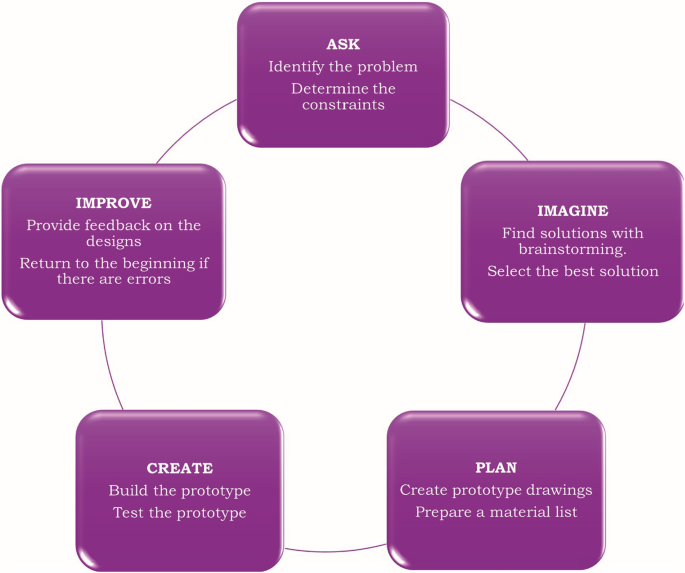
The specific stages and implementation of engineering design cycle-based STEM activities in elementary education remain unclear in many countries (English, 2017). Related literature reveals various models and steps related to engineering design processes (English, 2016; Engineering is Elementary [EIE], 2013; Brunsell, 2012; NRC, 2012; NAE and NRC, 2009). This study utilizes the five-stage engineering design process developed by Cunnigham and Hester, (2007). The stages are (a) asking questions, (b) imagining, (c) planning, (d) creating, and (e) improving (Cunnigham and Hester, (2007)). This model is also compatible with the “learning cycle” proposed by Gibb (2002): asking questions (opportunity recognition), imagining (innovation), planning (resource management), creating (risk-taking, collaboration), and improving (continuous improvement).
In the asking questions stage, the problem situation is defined and the constraints are discussed. Criteria for the success of the products to be created are also discussed at this stage. In the context of entrepreneurship skills, students acquire the skill of “identifying opportunities” as defined by Morris (1998), while also developing the competence of “analyzing problems” based on the model by Lesh and Zawojewski (2007). This stage allows students to explore real-world problems and approach them from a scientific perspective. In the imagining stage, brainstorming sessions generate ideas for various solutions, and the best solutions are chosen based on the goals. During this stage, students engage in the process of “developing innovative ideas,” which is a critical feature of entrepreneurship (Morris, 1998), while also applying the skill of “generating creative solutions” emphasized by English (2016). This stage encourages students to push boundaries and design alternative ways to solve problems. The planning stage involves reviewing material lists and creating drawings of the desired prototype. In this stage, students utilize entrepreneurial skills such as “identifying resources and conducting risk analysis” (Morris, 1998) and simultaneously develop “strategic thinking and organizing steps,” as proposed by Jonassen (2011). This process helps students develop a discipline of systematically solving complex problems by breaking them into manageable parts. In the creating stage, plans are implemented, prototypes are built and then tested. After testing, group of students are expected to analyze why their prototypes succeeded or failed. They provide scientific feedback on each other’s prototypes. Additionally, while engaging in the process of “implementing ideas and prototyping” (Morris, 1998), they also gain the skill of “testing through trial and error,” which is highlighted by Capraro and Slough (2008). This stage reinforces learning by making theoretical knowledge tangible through practical application. Finally, in the improving stage, discussions focus on the process and methods used by the groups. Students are expected to provide scientific insights on which prototype was the most effective, robust, and high-quality, and the reasons for its success. Subsequently, students work on modifying any prototypes that are incomplete or flawed. In the improving stage, students experience the “continuous improvement and adaptation” phase of the engineering design process (Morris, 1998). During this process, they revise their prototypes using critical thinking and problem-solving skills—highlighted by Shanta and Wells (2022) as key outcomes of design-based learning. Students embrace failures as learning opportunities and gain the competence to optimize designs using scientific methods.
It is thought that students will gain problem-solving and entrepreneurship skills through the processes mentioned above. One of the main objectives of science curricula is to prepare students for their future lives in terms of entrepreneurship by providing them with skills such as problem-solving, communication, and critical thinking (MoNE, 2024, 2018). Thanks to the problem-solving and critical thinking skills that students acquire in this process, their potential to start their own business or generate innovative ideas in the business world increases in the future (Achor and Wilfred-Bonse, 2013; Beca, 2007). The stages in the engineering design cycle allow students to develop creative solutions by systematically addressing problems. Thus, by experiencing engineering processes closely through STEM activities, students begin to develop their entrepreneurial characteristics at an early age. This aspect of STEM education can make significant contributions to students’ success in both their academic and professional lives in the future. Therefore, students acquire the skills necessary to achieve success both in their current education and in their future careers at an earlier age.
In recent years, research on engineering design cycle-based STEM education has been increasing in the literature due to the high-level skills it develops in students (Barnett et al., 2008; Bozkurt Altan et al., 2018; English and King, 2017; English and Mousoulides, 2015; Hiğde and Aktamış, 2022; McFadden and Roehrig, 2018; Özkızılcık and Cebesoy, 2020; Julià and Antolí, 2019; Wingard et al., 2022). When examining the research, it was found that while there were studies examining the problem-solving skills of elementary school students with engineering design cycle-based STEM education, studies examining entrepreneurship skills were limited. Moreover, the aforementioned studies were mostly conducted at the university (Chu et al., 2024; Watts and Hetherington, 2024), high school (Kaya-Capocci et al., 2024), and middle school levels (Kalik and Kırındı, 2022). This gap is of greater significance in contexts such as Turkey, where there is a need for applied education at an early age (Kaya-Capocci et al., 2024). For instance, within the scope of the activity titled “Making Cars from Food,” elementary school students engage in designing vehicles powered by fruits and vegetables using the engineering design cycle. Throughout this process, they are not only exposed to STEM disciplines but also experience entrepreneurship skills centered on resource management, product development, and sustainability. These include calculating cost-efficiency in material selection and presenting their designs with marketing strategies at an “Innovative Transportation Fair.” Such activities provide students with an integrated learning experience that combines technical knowledge with real-world economic and entrepreneurial thinking. The Ministry of National Education’s (MoNE) 2023 Education Vision has set the acquisition of entrepreneurial skills at an early age as a fundamental goal (Ministry of National Education MoNE (2018a)). However, it has been reported that entrepreneurship education at the elementary school level in Turkey is more based on theoretical knowledge rather than practical applications (Tarhan, 2019). Indeed, according to the views of classroom teachers, it is stated that the current practices are insufficient in developing entrepreneurial potential, and there is a need for more practical, interdisciplinary approaches (Yüksel and Yıldırım, 2024). This situation can be overcome through the interdisciplinary approach and real-life problem integration of engineering design cycle-based STEM education. As demonstrated in the aforementioned activity, where students simultaneously experience both technical skills (materials science, physics) and social skills (teamwork, persuasion strategies) in the design process, the balance between theoretical curricula and practice will be ensured, thus laying the foundation for a skilled workforce of the future in alignment with the Ministry of National Education’s objectives.
The purpose of this study is to examine how elementary school students can develop entrepreneurship (opportunity recognition, innovation, risk-taking, marketing) and problem-solving skills through engineering design cycle-based STEM education. Elementary school students’ familiarity with engineering processes and their diversity and scope can provide them with attitudes and habits that can be important agents of change and development. These gains can not only contribute to students’ current learning processes but also transform them into individuals who can more effectively and creatively solve the challenges they will face in the future and shape society. The research also focuses on understanding the effects of engineering design cycle-based STEM activities on the entrepreneurship and problem-solving skills of fourth-grade primary school students. This educational model is expected to foster innovative thinking and problem-solving skills in students as they delve into the creative aspects of engineering. The lack of structural mechanisms for interdisciplinary integration in Turkey’s education system (Ministry of National Education MoNE (2018a)) and the predominance of theoretical approaches in entrepreneurship education (Tarhan, 2019) further enhance the value of this study’s practice oriented STEM model. The proposed model eliminates the need for teachers to specialize in a single discipline, enabling them to adopt a guiding role centered on engineering processes. This represents a critical theoretical contribution to aligning STEM education with Turkey’s socio-economic needs (e.g., the shortage of a qualified workforce). At the same time, by increasing the entrepreneurial potential of students, they can be better prepared for the business opportunities and challenges they will face in the future. In this context, it is emphasized that the shortage of qualified workforce in STEM fields in Turkey is projected to reach critical levels in the coming years. (PwC Turkey & TÜSİAD (2017)). Addressing this gap is possible through STEM education models that equip students with interdisciplinary skills (such as problem-solving and innovative thinking) from early ages (Kılınç and Karabudak, 2024). This study can be considered theoretically original, as it is the first empirical investigation of the effects of engineering design-based STEM education on entrepreneurship and problem-solving skills at 4th-grade level in Turkey. It aims to offer a new pedagogical framework within the context of elementary school STEM education. Practically, it develops an in-class implementation guide and policy recommendations to promote the culture of ‘early-age entrepreneurship’ targeted in the Ministry of National Education’s 2023 Education Vision. The study seeks to fill a gap in the literature by enhancing elementary school students’ entrepreneurial skills (e.g., innovation, risk-taking) and problem-solving strategies through engineering design cycle-based STEM education.
Based on the above objectives, answers to the following questions were sought:
-
(1)
Is there a statistically significant difference between the pre-test and post-test scores of the entrepreneurship intention skills scale for the experimental and control groups?
-
(2)
Is there a statistically significant difference between the pre-test and post-test scores of the problem-solving inventory for the experimental and control groups?
-
(3)
What are the views of the experimental group students regarding the engineering design cycle-based STEM education after participating in the activities?
link