


User needs analysis
Interviews with teachers: understanding teaching
In the context of designing the educational application EDU-MAT COPERNICUS, a key research stage involved conducting in-depth interviews with teachers. These conversations aimed to explore and analyse pedagogical requirements and expectations of teachers regarding modern educational tools supporting the process of teaching and learning mathematics.
The interviews were designed using qualitative techniques, allowing for a deep insight into the experiences, opinions, and preferences of teachers. A semi-structured interview format was adopted, which allowed flexibility during the conversation, encouraging respondents to openly express their thoughts. Through the analysis of the interview content, key needs of teachers were identified, such as the need to integrate mathematical content with real applications, the necessity to adapt tools to the diverse learning styles of students, and the requirement for easy integration with existing educational systems.
Findings from the in-depth interviews provided valuable information on how teachers perceive the use of AR technology in education, what potential pedagogical benefits they see in it, and what technological and methodological challenges need to be overcome. These conclusions directly impacted the application design process, allowing for the creation of a tool that better responds to actual educational needs.
We discussed a range of issues during the in-depth interviews with mathematics teachers regarding their preferences and expectations for a mobile application using AR technology to present mathematical task content. These conversations revealed a diversity of experiences and opinions about modern educational tools. In the initial phase of the conversations, teachers shared their previous experiences with AR technology, with many of them having limited contact with such solutions. In most cases, their knowledge of AR was superficial and limited to the game Pokémon Go, with practical use in education being rare, encountered in museums. Nonetheless, there was noticeable interest in the potential of this technology in terms of increasing student engagement in the teaching process.
When asked about integrating the AR application with the current curriculum, teachers expressed the need to adapt the content to the existing educational programs. They emphasized that the application should be a supplement, not a replacement for traditional teaching methods. The topic of how AR can help students better understand abstract mathematical concepts through visualization and interaction was frequently raised. There was also hope that the use of AR could contribute to improving interest in learning mathematics, while also raising concerns about potential technological and pedagogical challenges. Concerns included difficulties in integrating with various mobile devices of students and the need to provide appropriate training for teachers. Teachers pointed out the necessity of providing training and technical support that would enable them to effectively use AR applications in teaching. They were primarily interested in specific, practical applications that could make the educational material more attractive and accessible. Analysing the effectiveness of AR applications was one of the key topics, with teachers indicating the need to develop methodologies for assessing the effectiveness of such tools in education. They emphasized that it is important to measure not only the students’ interest but, above all, their progress in learning.
Finally, teachers expressed their thoughts on the future of education with AR, optimistically looking at the possibilities it can open. At the same time, they emphasized that technology should support, not replace traditional teaching methods, highlighting the importance of equal access to new solutions for all students.
Surveying students: preferences and expectations of new technologies
Exploring the preferences and expectations that teachers and educators have towards the implementation of new technologies in the teaching process is key to designing a prototype application. Recognizing these aspects is fundamental for effectively designing interfaces, functionalities, and educational content of modern educational tools. The interviews confirmed that the design of educational technologies cannot occur in isolation from end-users, and understanding their preferences and expectations is essential to create valuable and engaging educational tools.
Before proceeding with the design of a mobile application using AR technology for teaching mathematics, in-depth interviews were conducted with primary school students in grades 4–8 to understand their preferences and expectations. These conversations aimed to identify potential functionalities and interactive aspects that could be implemented in the application to maximally adapt it to the needs of younger users.
During these discussions, students expressed great interest in using AR technology in learning. Many of them talked about mobile phones and tablets as everyday tools that can be used not only for entertainment but also for education. The topic of gamification also came up, which, according to the students, could significantly increase their motivation to learn. Students emphasized how exciting it would be to visualize abstract mathematical concepts in 3D space. They expressed a desire for the application to be interactive and allow them to explore mathematical issues by ‘touching’ and manipulating virtual objects. The concept of a guide in the form of a historical figure, such as Nicolaus Copernicus, was positively received, as he could introduce various topics and appeal to the students’ imagination.
From the product development perspective, the statements of the students provided clear guidelines on the direction in which the application should be heading. They recommended that the creation of content should focus on visual and interactive presentation, which would help them better understand and remember complex mathematical topics. Students also hoped that such an application could make learning mathematics more engaging and less frustrating. At the same time, students pointed out frequent problems with the correct spatial visualization of solid shapes, which causes problems with correctly solving mathematical tasks. These initial consultations were necessary to build an application that would not only deliver educational content but also be tailored to the preferences and learning style of young users. The result of these interviews was an understanding that for students, not only is the knowledge itself important, but also the way it is conveyed and the possibility of interacting with new technologies close to them. The key differences and similarities between teachers’ and students’ perspectives are summarized in Fig. 1.

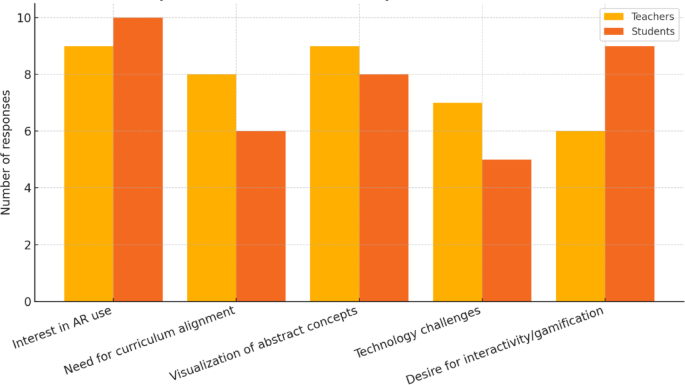
Comparison of key themes identified in qualitative interviews among teachers and students concerning the implementation of AR in mathematics education.
The role of parents and guardians in the process of technology-assisted learning
Interviews with parents of students attending tutoring focused on the role of parents and guardians in technology-assisted education. During these conversations, many parents expressed the view that they largely rely on teachers and tutors to take responsibility for the educational use of technology in their children’s learning. Parents often emphasized that by opting for tutoring, they expect professional educators to introduce students to the world of modern educational tools and to apply methods that will be most effective for the learning process. For many of them, tutoring is a way to provide their child with access to resources and experiences that they cannot offer at home, or do not feel competent enough to do so. Some parents admitted that they lack sufficient technical or pedagogical knowledge to effectively support their children in learning with new technologies. Others pointed to a lack of time and resources to keep up with their children’s school progress. It was emphasized that professional educators should be responsible for integrating technology into the educational process, and it depends on them how these tools will be used to maximize the learning potential. From these conversations, it was evident that parents view technology as an important element of education, but at the same time, delegate the responsibility for its use in the educational process to teachers. This was a sign of trust in educators and the expectation that they would be more effective in using technology for education than parents themselves.
In implementing a mobile application using AR technology to present mathematical content, these opinions may indicate the need to involve teachers in developing and adapting such tools to make them as effective as possible and for educators to feel competent. Understanding the role of parents and their expectations towards technology-assisted education is key to building an effective model of cooperation between school and home and creating an application that will support the teaching process, rather than additionally burden parents.
Needs evaluation
Guidelines for the educational application, which are the result of analysing the needs and expectations of three key groups: teachers, students, and parents, are indicated in Table 1.
In Table 1, key aspects should be considered when designing an educational application to meet the needs and expectations of teachers, students, and parents. It is important to remember that the success of an educational application often depends on its ability to engage all three groups and on the ease of integration and use in everyday school and home life.
A summary of the limitations and risks/threats for teachers, students, and parents associated with the implementation of an educational application is presented in Table 2.
Table 2 summarizes the key challenges and potential negative effects associated with the implementation of educational applications, which may be relevant to all stakeholders: teachers, students, and their families. It is worth noting that these risks can be mitigated through careful application design, user training, and ongoing technical support.
Technology assessment
Degree of innovation
A novelty in the Polish educational market will be providing a comprehensive offer of mathematical tasks using AR and VR technology and an online educational platform to present the content. All tasks refer to space technologies and the Copernicus, Galileo and EGNOS systems. Available tasks will be displayed in AR and VR and through the website.
The curriculum of teaching in schools introduces the necessity of space education. It usually boils down to a department related to a particular planet. Our product will bring the functioning of the most important space missions closer. Pupils reading the content of tasks will find out about the products and services of individual systems according to missions and space technologies.
The idea of the platform coincides with the National Space Program 2019–2021 in the part devoted to promotion, education and training, and in particular to the implementation of the core curriculum in the field of space education50. At the same time, AR solutions allow for spatial visualization of tasks and facilitate their understanding for people who do not have spatial imagination. All content of the tasks in the system will be related to the Copernicus, Galileo and EGNOS satellites. The narrator and the main character of the system will be Nicolaus Copernicus51. The properties and construction of Satellite Systems implemented by ESA will be presented indirectly. The content of tasks will always be based on the principles of operation of individual satellite systems. They will refer to their design, operating principles and products obtained from satellite systems. Despite the introduction of space education in the core curriculum in schools, there are very few materials on this topic in current school textbooks, and there is no comprehensive educational offer using AR and VR. The introduction of mathematical information about Earth observation systems in the content of mathematical tasks will increase the attractiveness of these tasks. It will stimulate students’ curiosity. In addition to solving tasks in class, several scenarios for maths classes outside the school are planned to be prepared using AR and GNSS positioning. The content of the tasks is based on the principles of operation of individual satellite systems.
Knowledge of the principles of satellite technology allows students to explain the possibilities of using satellite products in nature protection, safety, climate monitoring, weather forecasting, time measurement systems, etc. At the same time, it is possible to introduce interesting mathematical tasks. The use of AR and VR as new 3D visualization methods will help children understand tasks related to spatial geometry52. Children could see figures presented in a spatial form, not flatly drawn in perspective in the book. AR and VR technology will also facilitate translating tasks related to the concept of scale. Also, it will be much easier to translate tasks associated with the speed of objects. VR allows you to show objects in their original sizes with animations. Explaining the principles of the navigation systems Galileo and EGNOS will allow the youngest students to realize that there are also other positioning systems than GPS. In most cases, the term GPS is used instead of GNSS. Similarly, most users of products and services from satellite systems do not know their source. Society does not know the possibilities of their use in everyday life. The script prepared for interactive math tasks will have to be preceded by a short introduction about the operation of a particular system. For example, in the case of Sentinel 1, the principle of operation will be discussed. The task will be arranged with the surface area monitored by the system, e.g., knowing the parameters of the Sentinel orbit 2, you can create a task regarding the length of the satellite’s movement path or calculate the surface of the created figure. The role of time in satellite systems and coordinate systems will be presented. The wide application of satellite missions by ESA allows users to implement any part of mathematics at various difficulty levels. Accounting for the 12-year education process (the process of learning from the 1st grade of primary school to the final year), it can be assumed that it allows entering information about various space missions. It is necessary to directly use GNSS receivers in smartphones to display information in the AR, in scenarios of lessons outside the school.
Technology maturity
Not only traditional mobile devices such as smartphones, tablets, and their derivatives, but also professional devices including glasses and helmets make the AR applicable in professional systems for military applications, medicine, telecommunications, training, education, construction, and geodesy surveys, as well as solutions to ordinary users for navigation, LBS (location-based system) applications, and tourism. Due to the relatively short period of operation, the AR/VR market is highly dynamic, and there are many new platforms offering programming tools for building AR/VR-based solutions or dynamic development of existing products. The most popular ones are Vuforia, Wikitude, AR Toolkit, Droid AR, and Layer. They offer similar functionalities, i.e., tracking and recognition of 2D/3D objects, face recognition, assigning objects to the location, and simultaneous localization and mapping (SLAM) algorithms for object mapping. Some environments were created as products dedicated only to specific hardware solutions, such as Microsoft HoloLens and Tango. The development environment of the designed system will be Unity 3D. It is determined by the timeliness and openness of the development environment. It is characterized by high efficiency when creating applications using 3D objects and optimizing the application code when compiling it. The advantage of this environment is the ability to develop applications in AR and VR technology, which will allow us to create a coherent system environment. Unity also provides multi-platforming of final mobile solutions, including Android and iOS. The environment for creating the AR applications will be ARCore.
ARCore is Google’s platform for creating AR applications. With a wide range of features in a defined API, the platform allows the phone to detect the environment, understand the surrounding world, and interact with the user. Connecting the virtual world with the real world is possible primarily thanks to the ability to track the position of the phone in relation to the surrounding world (motion tracking), scanning and recognizing the size and location of horizontal, vertical and oblique surfaces (environmental understanding), and excellent evaluation of exposure conditions (light estimation)53.
Analysis of the market and business model
Modelling market scenarios for educational technology
In the face of dynamic changes in educational technologies, modelling market scenarios becomes key to understanding the possible futures of the education market. Educational technologies (EdTech) are developing at an unprecedented pace, leading to a continuous evolution of needs, preferences, and expectations of stakeholders.
Before starting work on a prototype solution, it is necessary to identify key market and technological trends that will shape the EdTech space, including the development of artificial intelligence, which enables personalized learning, adaptation of blended learning, increased use of big data analysis, increased access to mobile technologies, changes in educational policy, and evolving expectations of end-users. We can consider three basic development scenarios. In the optimistic scenario, all trends evolve favoring the adoption of new technologies, where education becomes fully personalized thanks to artificial intelligence and data analysis. In a realistic scenario, educational technologies develop at a balanced pace, where issues such as differences in access to technology or privacy of data are resolved gradually. Meanwhile, the pessimistic scenario focuses on possible challenges, including inequalities in access to education and resistance to change in traditional educational systems. Each scenario has significant implications for business models. In the optimistic scenario, companies can focus on innovation; in the realistic scenario, on finding a balance between innovation and user support; and in the pessimistic scenario, on breaking down adoption barriers.
Modelling market scenarios is essential for understanding how educational technologies can develop and what strategies companies should adopt to succeed in a changing environment. These scenarios are a tool for decision-makers and business strategists that allow for better preparation for various futures and ensure that educational products meet the real needs of the market. For an educational application to be effective and respond to real challenges in the field of education, it is necessary to conduct a deep analysis of the market segments the application aims to serve. These considerations include not only students and teachers as direct users but also the broader ecosystem in which the application operates, including parents, schools, teacher training centres, and even educational institutions at the regional and national levels.
The economic aspect also plays an equally important role during the analysis, examining the financial potential of the educational market, expenditures incurred by parents on education, and available models for financing educational projects. This makes it possible to understand the main sources of revenue and what pricing strategies should be adopted for the product to be competitive and yield the expected financial results. On this basis, revenue sources can be defined and then designed.
The business model of the application was presented using the Business Model Canvas tool (Fig. 2), which enabled the visualization of key components of the venture, such as value proposition, customer segments, distribution channels, customer relationships, revenue streams, key resources, key activities, key partnerships, and cost structure. The functional model provides a comprehensive understanding of both the opportunities and challenges facing an educational application in today’s market. The analysis helps define the business model of the application and allows for predicting market changes, adapting the product to user needs, and maintaining a long-term competitive advantage.

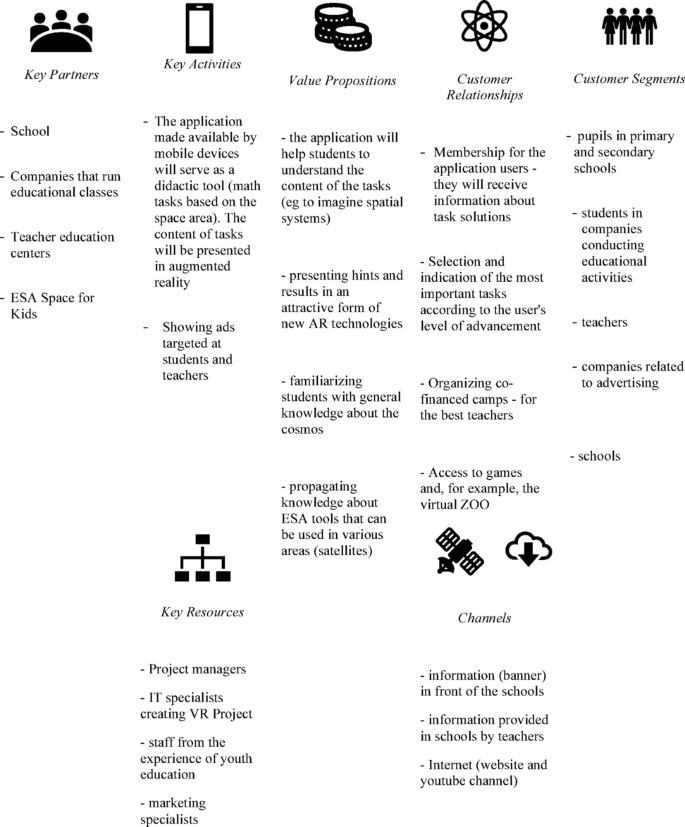
The Business Model Canvas.
Despite a well-defined value proposition, the successful implementation of the EDU-MAT Copernicus business model depends heavily on overcoming practical barriers, such as varying levels of digital literacy among teachers, potential resistance from educational institutions, and disparities in technological access across regions.
Market potential
This chapter presents an assessment of the market potential of the platform, based on the analysis of statistical data and market trends in the education sector in Poland. The business model for the EDU-MAT COPERNICUS platform reflects its hybrid nature as both an educational and technological tool. The primary target groups include private tutoring centres, individual students and their parents, as well as innovative public and private schools seeking to enhance their STEM curricula. The application is designed to function in both formal and informal education environments, such as extracurricular math programs or classroom pilot projects.
EDU-MAT COPERNICUS adopts a dual-access model. Individual users can purchase licenses or access content through a freemium structure, offering basic modules for free and premium content for a fee. Institutional clients, such as schools or tutoring services, can benefit from multi-user licenses and administrative panels to monitor student progress. This approach aims to balance accessibility with sustainability, though achieving this balance in practice could face challenges related to cost management and user affordability.
Importantly, the business model aligns with the platform’s educational mission. By offering differentiated access plans and incorporating feedback from both educators and students, the model supports the inclusive and scalable deployment of AR-based learning tools in real-world educational settings.
Considering the structure of users for the academic year 2023/2024, one can notice various types of schools in Poland, from primary, secondary, to post-secondary schools. This gives a picture of the potential user base of the platform, which, in terms of teachers, amounts to nearly half a million educational professionals. Such educational professionals indicate a large group of potential professional users of the platform, while the number of students exceeding 6.7 million means a vast market of individual consumers.
A study conducted by the Centre for Public Opinion Research on parents’ spending on education indicates that the average monthly expenditure is 585 PLN per child, with the largest investments coming from parents with higher education, which can reach up to 3600 PLN per month. These data show that parents are willing to invest in their children’s education, which may indicate their potential willingness to incur costs associated with new, valuable educational proposals offered by the platform54.
Considering market opportunities, a conservative market penetration level of 1–2% in the first year might be achievable, although actual engagement could vary significantly due to external factors such as technological infrastructure and user acceptance. Market growth prospects are optimistic, especially given the increasing trend of using e-learning methods in education in Poland. While EDU-MAT COPERNICUS presents an innovative educational solution, its potential commercialization faces several challenges, including market acceptance, equitable technology access, and scalability issues. Future implementations must critically assess economic sustainability alongside educational effectiveness.
In summary, the analysis shows that the market potential for an innovative educational platform in Poland is significant. Conclusions from the presented demographic data and the investment profile of parents suggest that the platform has a great chance of success, provided it is properly tailored to market needs, along with the necessity of further research into user preferences and adjusting functionalities in response to evolving educational standards and expectations.
Principles of creating e-learning materials
In today’s world of digital education, creating educational materials is a complex process that requires consideration of both the technological aspect and the psychological understanding of the target group. The dynamically developing technological environment simultaneously offers opportunities and challenges for educational content creators, who must balance innovation with accessibility and functionality of their products.
Choosing a programming environment is a critical factor for realizing interactive mathematical tasks, with the main barrier potentially being the quality of graphic design and the varying tastes of different age groups. When creating materials, it is crucial to develop attractive scenarios for individual thematic sections that will engage users and stimulate their intellectual development. However, a clear emphasis on graphic work can generate significant implementation costs.
Regarding technical risk, the use of AR technology can be distinguished. In this area, the existing state of knowledge and technology allows for the visualization of practically any mathematical task. The technical risk that can be defined arises from the need for potential users to have appropriate mobile devices. This risk is mitigated by the rapid development of the smartphone market and increasingly wider internet access.
The intended method of identifying user requirements is based on agile methodology, which allows for iterative approximation to the expectations of end-users, meaning functional verification of components in a laboratory environment. When creating the system, it is necessary to consider the basic elements of interactive materials that users pay attention to. Key elements include (Fig. 3; Table 3): support for electronic textbooks, content composition, textual, graphic, sound, multimedia and interactive layers, as well as communication, reporting, conducting lessons and tests, and the ability to print results. Collaboration with additional software is also important, where the API should allow integration of the platform with other systems. It is also necessary to define the minimum hardware requirements for computers, tablets, smartphones, and websites. In summary, creating educational materials is not only a response to educational needs but also a technological challenge. Collaboration with users and adaptation to changing trends are essential for the success of educational platforms.

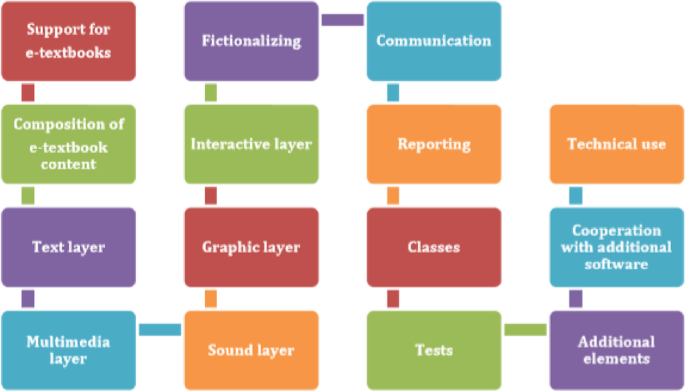
The key elements of interactive materials.
The role of parents and guardians in the process of technology-assisted learning
The concept of a technical solution is based on GNSS technology and AR technologies. Combining these two technologies to create an educational tool is possible thanks to the dynamic development of mobile devices. Currently, the use of GNSS systems in Civil Applications is very popular.
The EDU-MAT system is based on a three-layer architecture, where the following components will be connected: layer I—base supply, layer II—data storage and analysis, and layer III – information (Fig. 4). The main task of the base layer is to enter data about classes conducted by companies based on data input interfaces operating in a web browser. The data storage and analysis layer (data warehouse) is physically implemented in the form of disk arrays operating in both the SAN (Storage Area Network) and the NAS (Network Attached Storage) file model, and logically as the RDBMS (Relational Database Management System) and/or the file system associated with it. Its tasks are: (1) providing systematic storage, in terms of logic, rights, and optimization of access time to data and information obtained from companies (functionality related to the network client module); (2) processing data according to the assumed criteria with sub functionality associated with the data processing client module, i.e. business logic; and (3) ensuring access authorization and optimized access to information using functionality associated with the data processing engine module. The business logic sub-layer, the heart of the EDU-MAT system, is a specialized layer of processing aggregated data. The purpose of its operation will be to monitor the operation of the system and adapt the interface to changing needs. Thus, it will be possible to update information relevant to the potential user. Layer III for information sharing will be prepared with particular emphasis on mobile devices. The interface will allow the user to enter a filter for the needed information to learn about the class, including determining the search area, such as difficulty level and class.

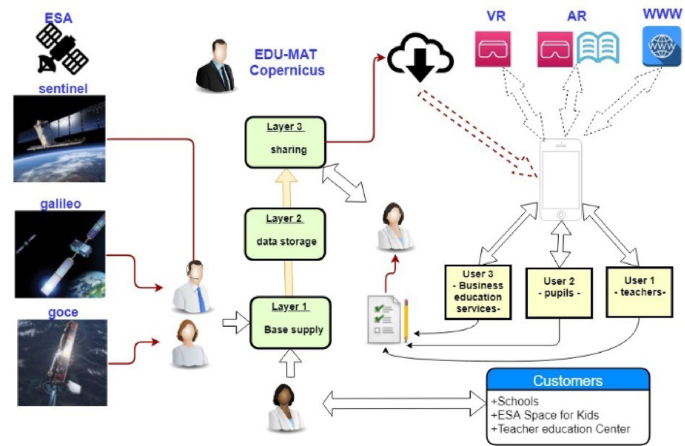
Architecture scheme of the proposed system (EDU-MAT Copernicus).
The ARCore layout can be divided into four basic levels of display and navigation within the application: main menu, thematic section selection menu, task selection menu, and menu displaying the content and test questions (Fig. 5).

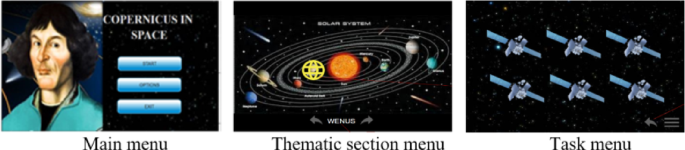
Layout of individual view bars.
This system design allows for a smooth transition between views. The application user decides which content should be displayed in AR. The first possibility, AR animation, is based on the displayed solar system, in which the user can select a particular thematic section (Fig. 6).

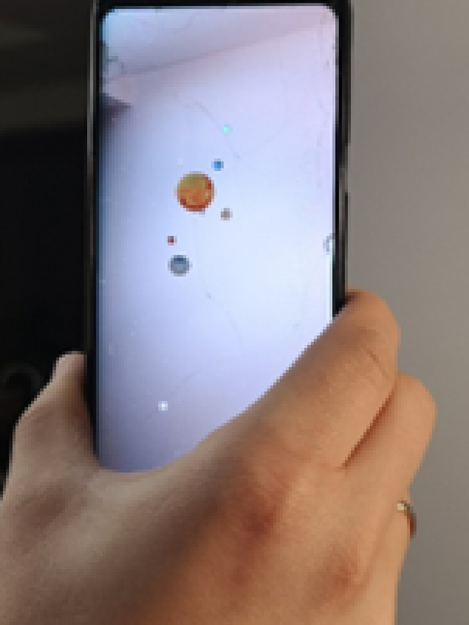
Example view of the solar system in AR.
Examples of integrating mathematics with Earth observation technologies
The two examples of tasks combining the mathematical content of shortened multiplication formulas with the content of geosciences tasks (Sentinel operation) are presented below55,56. The first thing displayed before the test questions is a short graphic about the individual task (Fig. 7).

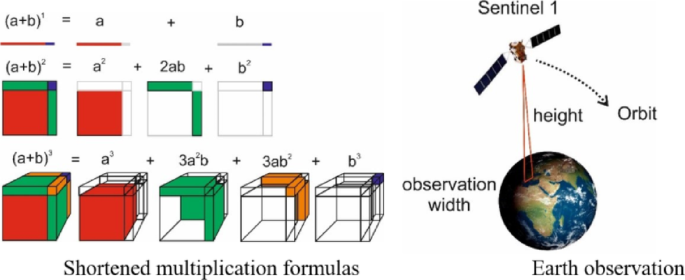
The example of tasks displayed in the system. Map data: Google Earth57.
In the case of the Sentinel operation, the quotations about the shortened multiplication formula or the field of the red pyramid can be asked based on the two thematic problems displayed. It is much easier to understand the presented content when it is possible to combine 3D views. Each detailed information is linked. Therefore, it is possible to expand one’s knowledge of the specific subject. An example of linking to detailed knowledge concerning Earth observation missions is presented in Fig. 858,59.

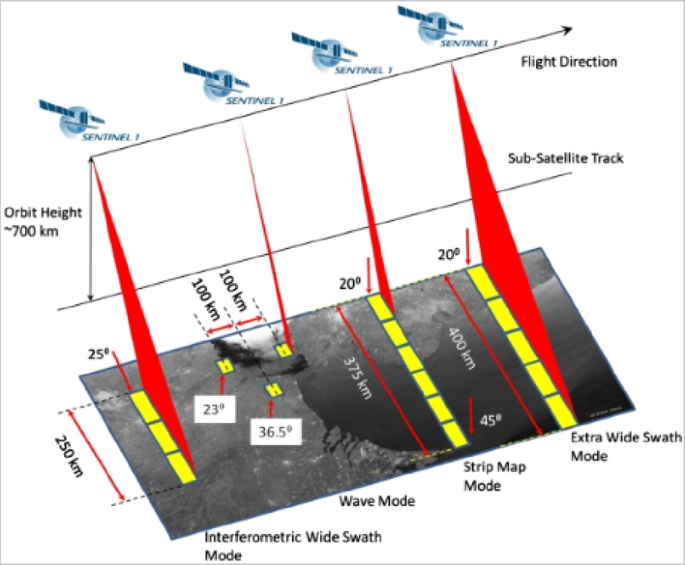
The detailed information concerning Sentinel-1 Product Modes60.
The system is assumed to operate mainly on smartphones. The target platform for the EDU-MAT COPERNICUS environment provides the ability to use the computing power of a smartphone, space assistive devices (GNSS receiver, gyroscope, and accelerometer) and a camera to construct the content of the tasks.
Prototype verification and optimization
The analysis of cognitive processes related to the test of the EDU-MAT educational application prototype was focused on cognitive load theory and the information processing model. Cognitive load theory, developed by John Sweller, focuses on optimizing the learning process by effectively managing the load on working memory61. During the testing of the EDU-MAT application, three key forms of cognitive load were identified: intrinsic, related to the complexity of the material itself; extraneous, resulting from the form of content presentation; and germane load, which includes active assimilation and processing of information.
The EDU-MAT application, utilizing AR and GNSS technologies, aimed to reduce extraneous load through intuitive interfaces and advanced 3D visualizations, facilitating the understanding of complex concepts. At the same time, by dividing content into manageable thematic blocks, an effort was made to limit the intrinsic load of the users. The germane load associated with learning was stimulated by including interactive elements such as tasks and games that engaged students in the learning process.
In the context of the information processing model, which assumes the gradual processing of data from sensory perception, through short-term memory storage, to long-term memory, the EDU-MAT application created rich sensory experiences. These experiences were intended to aid students in encoding and long-term storage of information.
The testing results showed that teachers tended to engage more deeply in exploring the features of the application, indicating a greater load associated with the learning process. On the other hand, students tended to focus on visual and interactive elements, which could reduce their cognitive load, both intrinsic and extraneous. These observations suggest that it is crucial to design digital educational tools considering the various aspects of cognitive load. This approach not only allows for delivering content in an attractive and accessible way but also promotes deeper information processing and constructive engagement of users in the learning process. Ultimately, the EDU-MAT application, implemented with such design principles in mind, has the potential to improve the effectiveness of the educational process by facilitating the acquisition and consolidation of knowledge in a way tailored to the individual cognitive abilities of users.
link