


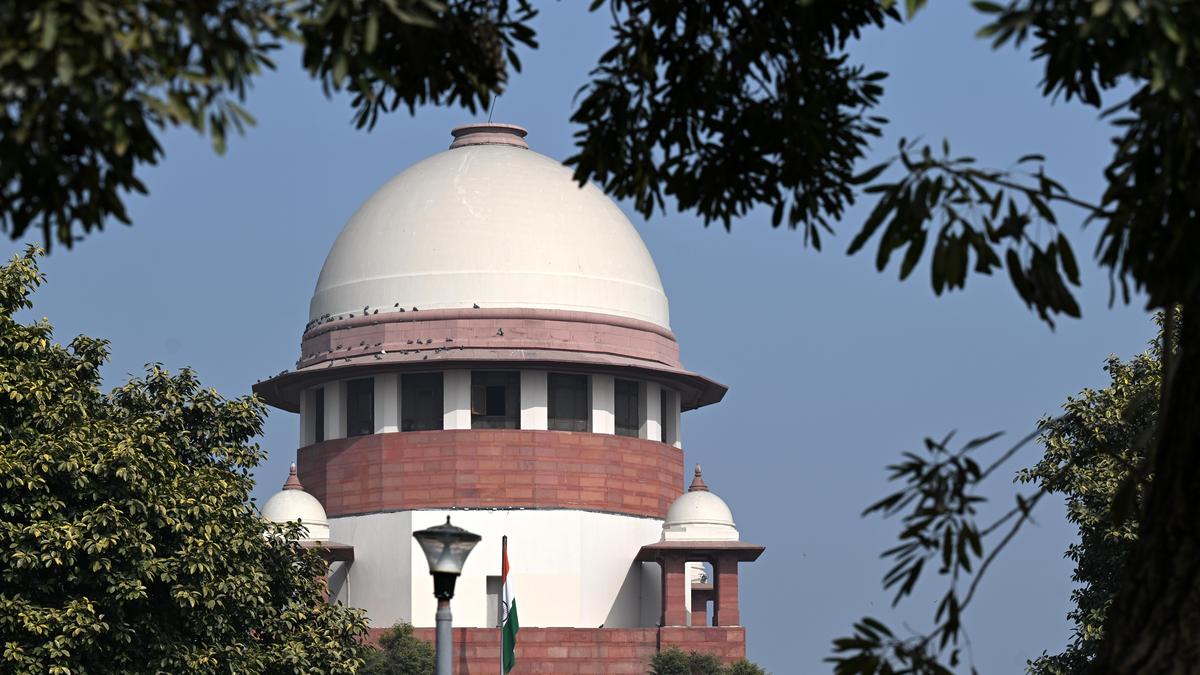


Purely quantitative expansion without any adequate institutional support framework has left students vulnerable, as directly evidenced by the recurring instances of campus tragedies, the Supreme Court noted.
| Photo Credit: The Hindu
The Supreme Court has observed that “massification” and “privatisation” of higher education have placed India second globally in student enrolment, but the rush has left behind a trail of deaths, distress, chronic vacancies and exploitation.
Invoking the court’s plenary powers under Article 142 of the Constitution, a Bench of Justice J.B. Pardiwala and R. Mahadevan, in a 38-page order, issued a series of directions, including that vacant faculty positions in both public and private higher education institutions (HEIs) must be filled within four months. Appointments of Vice-Chancellors and Registrars must be made within a month of the posts falling vacant, as a matter of practice.
The backlog of pending scholarship disbursements must be cleared within a period of four months by the relevant Central and State government authorities. Disbursements of future scholarships should have clear timelines, the court ordered.
It said the number of incidents of students crumpling under pressure to take their own lives has reached “epidemic” proportions even as the National Education Policy, 2020 had set an ambitious target of achieving a 50% Gross Enrolment Ratio by the year 2035.
Purely quantitative expansion without any adequate institutional support framework has left students vulnerable, as directly evidenced by the recurring instances of campus tragedies, the court noted.
Students who interacted with a Supreme Court-appointed National Task Force (NTF) during a survey shared that “extremely rigid attendance policies, overburdening and unplanned phasing/scheduling of the academic curriculum, exam assessment methodologies, faculty shortage, vacant teaching posts, excessive reliance on inexperienced guest faculty, non-transparent or non-existent placement processes” were stressors affecting their mental health.
Medical students spoke about the entrenched borderline exploitative academic culture coupled with on-call hours being stretched well beyond the prescribed limit – going as far as 36 to 48 hours in one go. Engineering students highlighted the intense nature of academic expectations heavily driven by placements and salary packages.
The court said it was high time to look into the submerged sections of the “iceberg of student distress”.
“HEIs cannot shirk away from their fundamental duty to ensure that their institutions as a whole are safe, equitable, inclusive and conducive spaces of learning,” the court observed.
The NTF found that around 65% of the institutes currently did not provide access to mental health service providers. The court directed that residential HEIs must provide access to round-the-clock qualified medical help, if not on campus, then within a one-km radius to provide emergency health support to students.
In its directions, the court ordered that the ‘Sample Registration System’ data on suicides, especially those falling within the age group of 15-29 years, must be centrally maintained for better and more accurate estimates of deaths by suicide among students in HEIs. The National Crime Records Bureau’s annual report should distinguish between school-going students and students of higher education in its categorisation of ‘student suicides’.
All HEIs must report any incident of students taking their own lives or unnatural deaths of students, regardless of the location of its occurrence, be it on campus, hostels, PG accommodations, or otherwise outside the institutional premises, to the police as soon as they come to know about the incident.
“The Union of India and State governments shall make sure that the directions given by us are communicated to all HEIs across the country, at the earliest and appropriate action is taken in this regard,” the Supreme Court ordered.
Published – January 18, 2026 07:53 pm IST
link